| current funding | |||

|

|

|
|
| past funding | |||

|

|

|

|

|
|

|

|

|

|
|

|
Research
Our work examines biological systems through the prism of Soft Matter and Statistical Physics. By properly exploiting their symmetries, we strive to make robust statements that give valuable insights into the mechanics and thermodynamics of these complex living objects. Although this work is theoretical, we are fortunate to have numerous fruitful collaborations with experimentalists.
In the following the names of experimental collaborators are italicized. Some earlier research projects are described here.
Fibrous aggregation of deformable irregular objects

Fibrous structures formed by aggregating irregular objects in numerical simulations |
Protein fiber formation is involved in many diseases including Alzheimer's, sickle cell anemia and type II diabetes. Although this behavior has been attributed to the specific physico-chemical characteristics of proteins, we propose that this behavior can be expected from a broad class of aggregating objects. Indeed, while simple objects such as spherical colloids tend to aggregate into three-dimensional crystals, such a regular arrangement may not be compatible with particles having a more rugged geometry. We thus propose that under certain conditions, fiber formation could be a generic characteristic of attractive irregular objects with short-range interactions. Collaborators:Tom Witten, Monika Spano Publications:
Deformable frustrated particles form fibers (2017) |
Frustrated self-assembly of anisotropic subunits
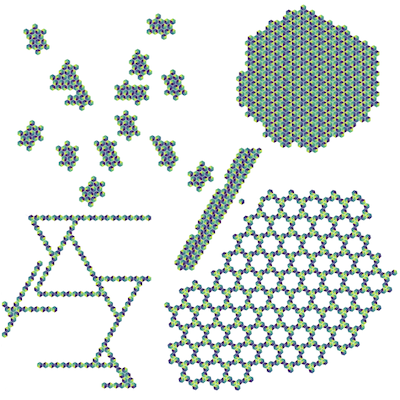
Hexagons with face-specific interactions form varied assemblies. |
Self-assembly is not only an important process for the living cell, but can also be harnessed to engineer very small objects. Thanks to recent progress in DNA technology, experimentalists can now exquisitely control the interactions between artifical subunits on the nanoscale. We believe that this enables much more subtle design strategies than are currently used. In particular, we suggest that the use of frustration, i.e., situations that feature a competition between incompatible interactions, can unlock the ability to cheaply form structures in a way that had not been thought possible. Collaborators:Pierre Ronceray, Friedrich Simmel Publications:
Assemblies fall into few categories (2024) |
Self-assembly of 3D-printed colloids
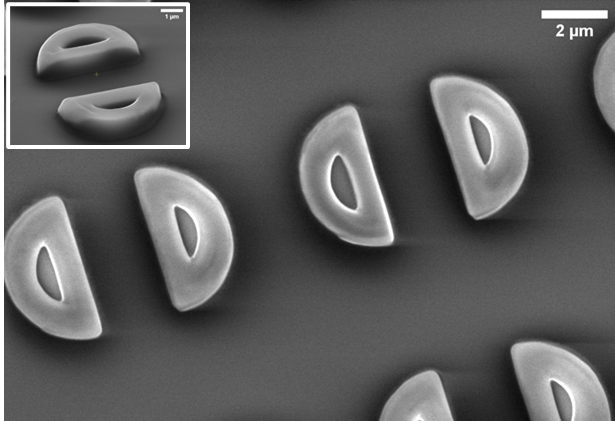
Electron micrograph of 3D printed colloids before they start assembling. |
To test our ideas on self-assembly, we develop an experimental platform that allows us to taylor the subunits' shape and interactions. Our setup is based on micrometer-sized colloids that bind to one another through depletion interactions. We 3D-print these subunits, which allows us to control both their overall shape and the texture of their faces. By combining these parameters we achieve a fine control over their interactions. Collaborators:Olivia du Roure, Julien Heuvingh Publications:Control of binding energy between 3D printed colloids (2025) |
Elasticity of branched actin networks

Branched actin networks (green) trapped between magnetic colloids and mechanically probed with unprecedented accuracy by collaborators du Roure and Heuvingh |
In addition to contributing to the static architecture of the cell, F-actin can power its motion by polymerizing and exerting forces in the direction of its movement. The networks involved in this process have a distinctive branched architecture, and are among the stiffest actin assemblies found in the cell. Despite the importance of their mechanics, however, the rigidity of these networks is not well understood from a theoretical standpoint. We examine the origin of this medium that the network grows against influences the mechanical characteristics of the cell. This helps us understand how the internal architecture of the cell tunes itself to adapt to its mechanical environment. Collaborators:Olivia du Roure, Julien Heuvingh, Clément Campillo, Marie-Émilie Terret, Cécile Sykes Publication:
Branched actin structure account for network rupture (2020) |